What is AEO (Answer Engine Optimisation)? The 2026 guide for B2B marketers
A practical guide to answer engine optimisation (AEO): what it is, how it differs from SEO and GEO, and how to get cited in AI search.

For more than 25 years, search engine optimisation (SEO) has been a core part of any serious marketing strategy, and most business owners and marketers know what it involves. In the past couple of years, though, a cluster of new terms has entered the conversation: GEO, AIO and AEO. The landscape is shifting quickly, so it’s easy to lose track of what each one means.
This article focuses on answer engine optimisation (AEO): what it is, why it matters, and how it differs from SEO and GEO.
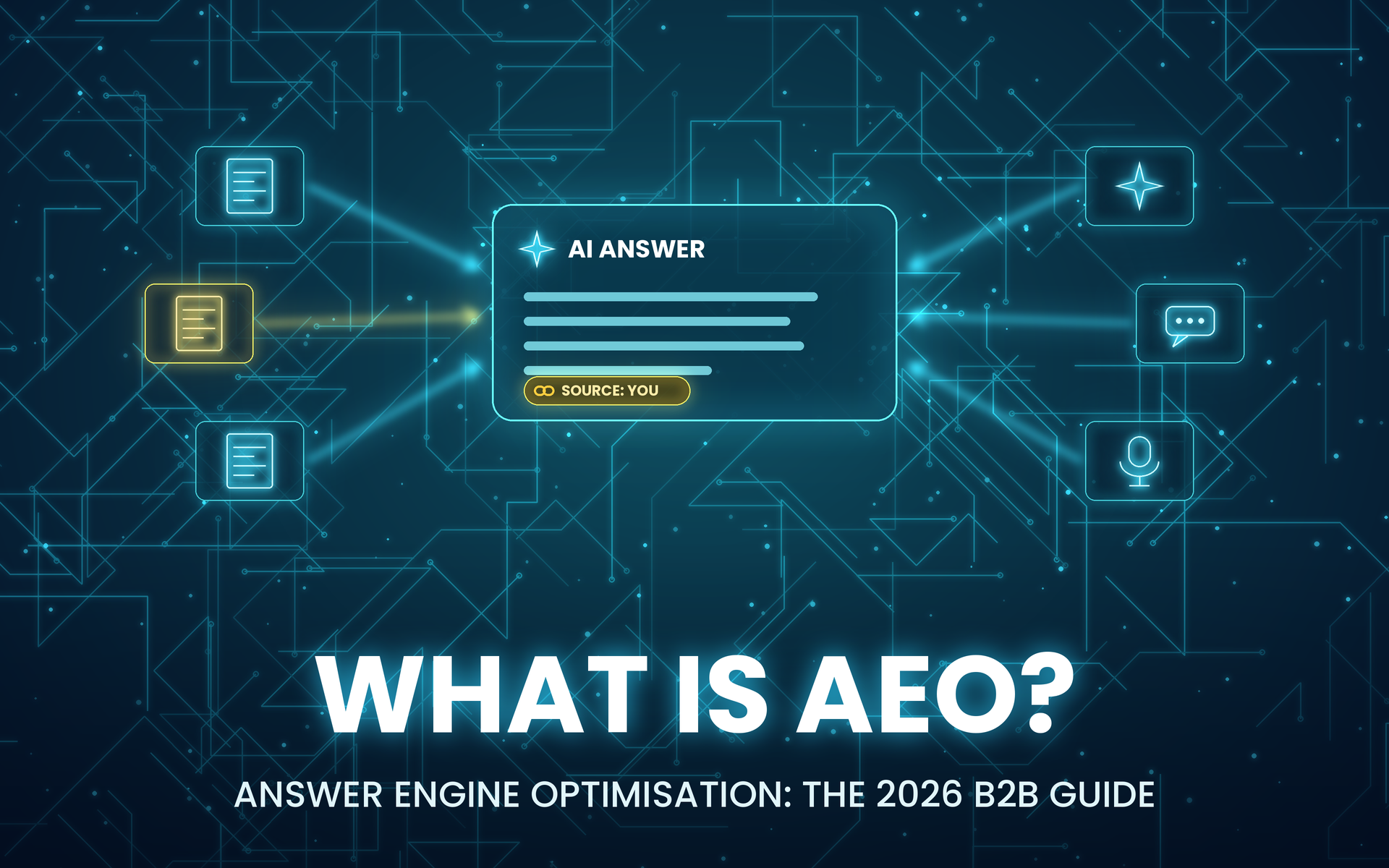
In short, AEO is the practice of writing and structuring content so that AI-driven search tools can extract it and cite it in their answers, rather than simply listing it as a link. Those tools include Google AI Overviews and AI Mode, ChatGPT, Perplexity, Microsoft Copilot and voice assistants.
Google AI Overviews now appear in an estimated 43% of US searches (Similarweb, May 2026). Pew Research found users clicked a traditional search result on 8% of visits when an AI summary appeared, against 15% when one did not. For B2B brands, that creates a straightforward choice: appear in the AI answer, or become less visible.
What is AEO?
AEO stands for Answer Engine Optimisation. An answer engine is any system that returns a direct answer rather than a list of pages. Think Google AI Overviews, Perplexity, ChatGPT Search, Microsoft Copilot, and Siri among others. AEO is the practice of making your content the source those systems choose to cite. AEO and SEO are not alternatives: AEO builds on the same foundations of indexable, authoritative, well-ranked pages so traditional SEO still has its place.
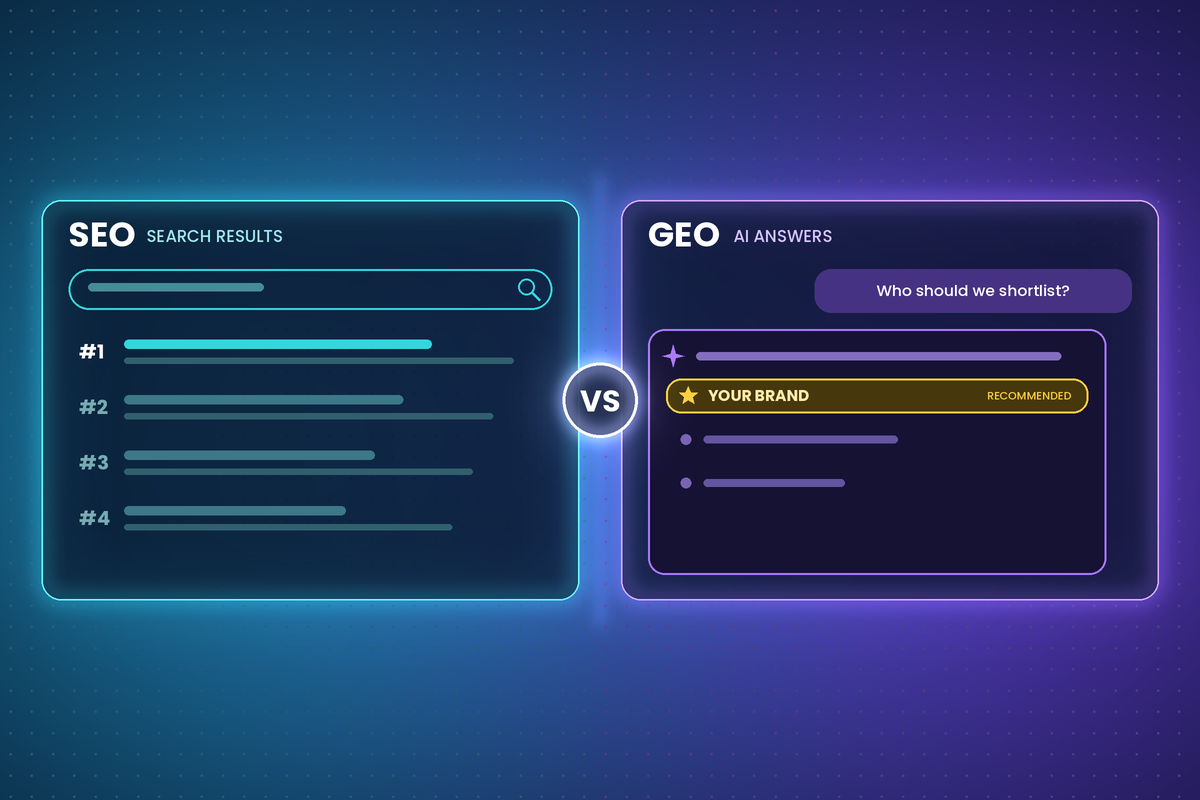
AEO vs SEO vs GEO. What is the difference?
A note on terminology first: many practitioners use AEO and GEO interchangeably, and there is no settled industry standard. The distinction we use at My Bright Digital is a working one, not a universal definition, and it is based on outcome rather than platform (the same tool, such as ChatGPT, can both cite your content and recommend your brand):
The strategic shift, as we described in our article on the evolution of search, is from targeting keywords to owning an entity. That is, the sum total of your brand's digital footprint across the web.
Why does AEO matter more now?
Two changes in 2025-26 made AEO material for businesses that might previously have deprioritised it.
Google AI Overviews now appear on a large share of informational queries.
Estimates vary widely by method and market. Similarweb puts AI Overviews on 43% of US searches in May 2026, up from 15% a year earlier; other studies put the figure nearer 13%. Ahrefs found that when an AI Overview appears, the top-ranking page’s click-through rate is 58% lower on average. Being cited inside the Overview partially offsets that loss: Seer Interactive found cited brands averaged 2.07% organic CTR on informational queries, against 0.94% for brands that were not cited. Not being cited compounds it.
AI tools became a primary research channel for B2B buyers.
G2's 2026 AI Search Insight Report surveyed 1,076 B2B software decision-makers in March 2026. 51% now start their research in an AI chatbot more often than in Google, and AI chatbots were the top source shaping vendor shortlists (54%), ahead of software review sites. Buyers also said review-site citations were the signal that gave them most confidence in an AI-generated answer. If your firm is absent from those answers, you are absent from an early-stage evaluation you will never know took place.
What do answer engines actually look for?
Five factors are most reliably associated with AEO performance:
- Direct answers first. State the answer in the first 50 words. Answer engines look for the sentence or paragraph that directly addresses the question. If the definition is buried in paragraph four, a competitor who leads with it will be cited instead.
- E-E-A-T and cited sources. Named authors with demonstrable credentials, cited sources, and consistent subject-matter expertise across multiple pieces all strengthen the trust and expertise signals Google describes as E-E-A-T (Experience, Expertise, Authoritativeness and Trust). Adding quotations and statistics can raise AI visibility by up to 40%, whereas generic,unsourced content rarely gets cited.
- Consistent entity presence across the web. If your website, LinkedIn, industry directories, and press coverage all describe you in consistent terms around the same expertise, you become a high-confidence entity. Being listed and reviewed on platforms such as G2, Clutch and sector-specific directories matters as much for AEO as for traditional SEO.
- Question-structured headings. Headings written as questions match the natural language of AI prompts. This is a reasonable optimisation, though the precise magnitude of its effect is not yet independently measured.
- Technical access for AI crawlers. Often overlooked, and usually quick to fix. AI crawlers such as OAI-SearchBot (ChatGPT), PerplexityBot, and Bingbot, need to be able to reach and index your content. Since 1 July 2025, new domains added to Cloudflare block known AI crawlers by default. Content that only renders after JavaScript executes may also be invisible. Check your robots.txt, your Cloudflare settings, and your server logs or Cloudflare’s AI crawler reports to see which bots are actually reaching your site (Search Console’s crawl stats only cover Googlebot).
How do you optimise for answer engines in practice?
Four practical starting points:
- Audit your existing high-performing pages. Are the opening paragraphs answering the question directly? Are authors named and credentialed? Are external sources cited?
- Rewrite introductions to lead with the answer. State it in 40-60 words, then add context below.
- Build entity presence. Being cited on review platforms, sector directories, and in press coverage matters for AI recommendation.
- Check technical crawlability. Review robots.txt for OAI-SearchBot and PerplexityBot. Check Cloudflare's AI bot settings. Use Bing Webmaster Tools' AI Performance report and check Google Search Console’s Generative AI performance report (still rolling out), which shows AI Overview and AI Mode impressions by page, but not the queries or clicks behind them.
On schema markup: Article schema and Person (author) schema remain valid and recommended. FAQPage schema is still allowed, and Google says it continues to use the markup to understand pages, but it no longer earns visible rich results in Google Search following Google's withdrawal of FAQ rich results for all sites on 7 May 2026. HowTo rich results were similarly withdrawn in 2023. Google also states that no special schema is needed to appear in AI Overviews or AI Mode.
Is AEO relevant for every business?
The strongest returns are in B2B services, professional services, and SaaS where buyers research extensively before purchasing, and where authority and trust are buying criteria. For commodity or price-led purchases, the calculation is different.
The practical test you can apply now: run five queries your ideal clients ask at the research stage in ChatGPT and Perplexity. If your competitors appear and you do not, AEO is worth addressing. If nobody in your sector appears, there is a first-mover opportunity.
If you’ve run that test and your competitors are showing up where you aren’t, we can help. My Bright Digital works with B2B firms in fintech, legal and professional services to make their content visible in AI Overviews, ChatGPT, Perplexity and Copilot. We run AEO audits as part of our SEO service or as standalone engagements. Each audit looks at your content, authorship, entity presence and technical crawlability, then sets out the changes that will make the most difference.
Sources and further reading
- Aggarwal et al. (Princeton/KDD 2024) — Generative Engine Optimization. Quantified factors that raise AI visibility. https://arxiv.org/abs/2311.09735
- Google Search Central — AI features and your website. https://developers.google.com/search/docs/appearance/ai-features
- Ahrefs, 2026 — Update: AI Overviews reduce clicks by 58%. https://ahrefs.com/blog/ai-overviews-reduce-clicks-update/
- Pew Research — Google users less likely to click links when an AI summary appears. https://www.pewresearch.org/short-reads/2025/07/22/google-users-are-less-likely-to-click-on-links-when-an-ai-summary-appears-in-the-results/
- G2 — The Answer Economy: 2026 AI Search Insight Report. https://learn.g2.com/g2-2026-ai-search-insight-report
- Digital Applied — AI Overviews appear in 13% of queries. https://www.digitalapplied.com/blog/ai-overviews-13-percent-queries-seo-traffic-impact
- Similarweb — 2026 Generative AI Landscape report: AI Overviewson 43% of US searches. https://www.similarweb.com/corp/reports/2026-generative-ai-landscape/
- Search Engine Land — Bing Webmaster Tools AI Performance report.https://searchengineland.com/bing-webmaster-tools-testing-new-ai-performance-report-468039
- Search Engine Journal — Google now reports AI search impressionsin Search Console (2026). https://www.searchenginejournal.com/google-reports-ai-search-impressions-how-to-read-them/582824/
- Google Search Central — FAQ (FAQPage) structured data documentation (FAQ rich results withdrawn 7 May 2026). https://developers.google.com/search/docs/appearance/structured-data/faqpage
- Seer Interactive — AIO impact on Google CTR: 2026 update. https://seerinteractive.com/insights/aio-impact-on-google-ctr-2026-update
- Cloudflare default AI crawler blocking for new domains, 1 July2025. https://www.cloudflare.com/en-gb/press/press-releases/2025/cloudflare-just-changed-how-ai-crawlers-scrape-the-internet-at-large/