What is GTM Engineering? The role redefining B2B revenue teams in 2026
What GTM Engineering is, what the work looks like across the customer journey, and how it differs from RevOps. A practical B2B guide.

If you’ve been in a B2B revenue conversation in the last 12 months, you’ve probably heard the term GTM Engineer. It’s appearing in job descriptions, on LinkedIn, in agency pitches. But definitions vary and the concept is new enough that most people have a loose sense of what it means rather than a precise one.
This article explains what GTM Engineering is, what the work looks like in practice and where it can help a business improve its revenue process.
What is GTM Engineering?
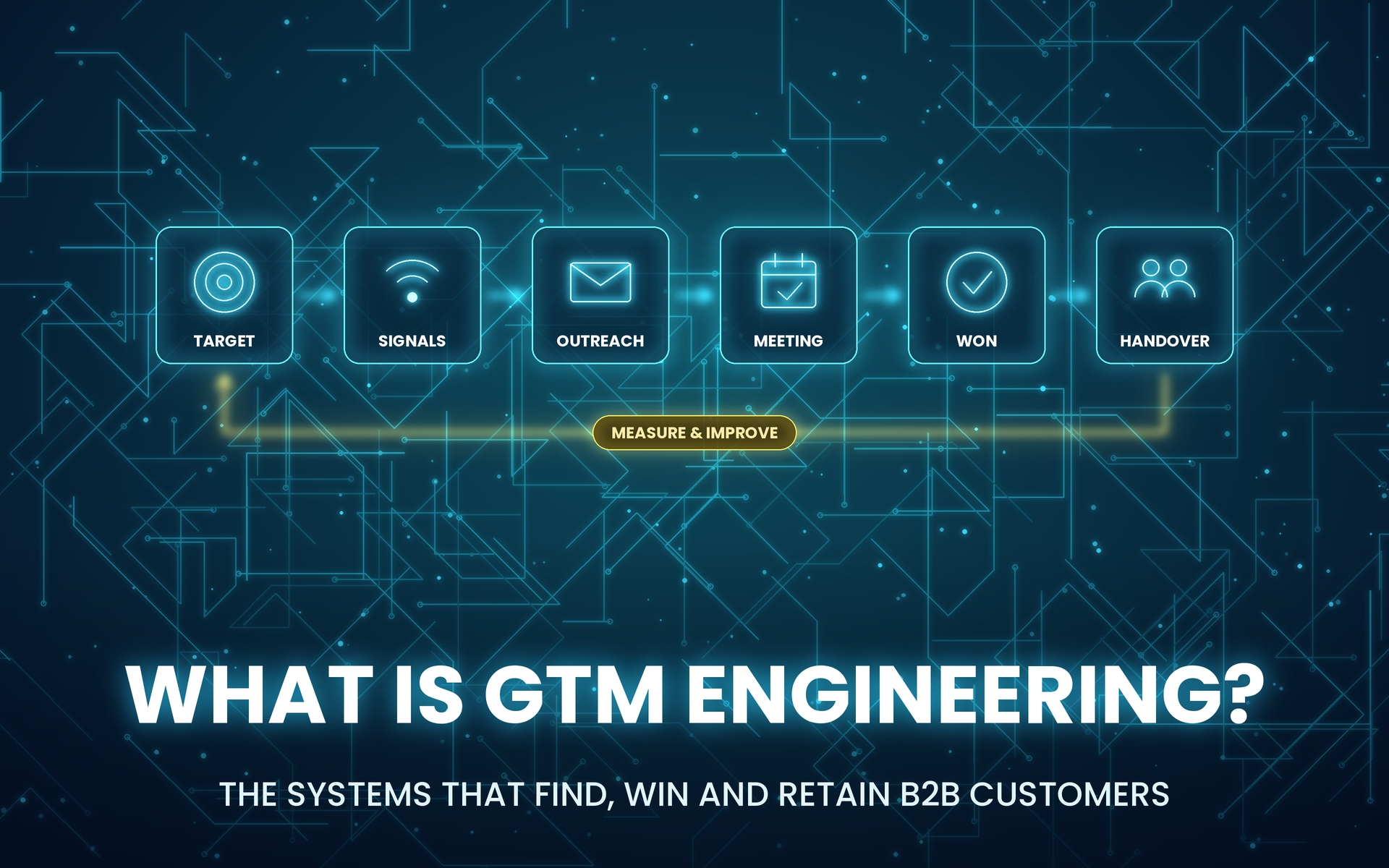
GTM stands for go-to-market. GTM Engineering is the practice of designing, building and improving the systems that help a business find, win and retain customers. It connects commercial strategy, data, technology and people, from identifying the right market through to outreach, sales follow-up and customer handover.
The starting point is a business problem: good enquiries aren’t getting a quick response, salespeople spend too long researching, or opportunities stall without a clear next step. A GTM Engineer works out why, builds a practical solution and measures whether it improves the outcome.
In practice, GTM Engineering typically involves:
● Lead enrichment pipelines: combining firmographic, technographic and intent data to build a fuller picture of each account, which supports qualification rather than replacing it
● Signal-informed outreach: prioritised using relevant signals (a pricing page visit, a new funding round, a job posting) and checked against account fit, rather than sent on arbitrary time intervals
● CRM architecture: designing the data model so your CRM reflects reality rather than being a graveyard of stale contacts
● System integrations: connecting the tools in your stack so data flows cleanly between them without manual intervention
● Revenue reporting: building dashboards that show what is actually driving pipeline, not just what is easy to measure.
What does a GTM Engineer actually do?
The GTM Engineer sits at the intersection of technology, data, and revenue strategy. It is not a purely technical role and it is not a purely commercial one: it is both.
In practice, the work spans the whole customer journey:
● Market mapping and targeting: Translate the ideal customer profile into account-selection criteria, identify relevant companies and decision-makers, and prioritise where the sales team should focus.
● Research and data quality: Combine information from different sources, verify contact details, remove duplicates and keep records current. Enrichment supports qualification; it doesn’t automatically make someone a qualified lead.
● Signals and prioritisation: Identify relevant changes such as hiring, expansion or engagement, then assess them alongside account fit and relationship history. A signal gives the team a reason to investigate, rather than proving someone is ready to buy.
● Outbound campaigns: Build relevant audiences, prepare messaging, connect email and other channels, and manage follow-up rules. Check existing conversations and stop outreach when someone replies, books or opts out.
● Inbound lead handling: Capture enquiries, add useful company context, route them to the right person and support timely follow-up. Track whether those enquiries turn into meetings and opportunities.
● Sales preparation and follow-through: Prepare account briefs before meetings, turn call notes into requirements and next steps, draft follow-ups and update the CRM.
● Pipeline reactivation: Identify older opportunities, understand why they stalled and decide whether there is a relevant reason to reopen the conversation.
● Customer handover and expansion: Pass agreed scope, commitments and stakeholders to the delivery team. Where appropriate, build processes for onboarding, renewal reminders and identifying expansion opportunities.
● Reporting and experimentation: Connect activity to qualified meetings, opportunities and revenue. Test targeting, messaging and workflows, then use the results to decide what to improve or stop.
● System reliability: Monitor failed workflows, missing data and broken integrations. Build in checks and human review so errors don’t quietly spread through the process.
What does that look like across the whole journey?
As an example, imagine a business wants to reach companies opening new locations. The GTM Engineer defines which companies fit, builds a way to identify expansion signals and researches the relevant decision-makers.
Before outreach, the workflow checks the CRM and previous conversations to avoid contacting existing customers or chasing someone already speaking to the team. It prepares a relevant approach for review and routes responses to the right salesperson.
Once a meeting is booked, follow-ups stop and the salesperson receives an account brief. After the call, requirements and agreed actions are captured in the CRM. If the deal closes, the delivery team receives the information needed for onboarding.
Throughout the process, the business measures which signals and messages produce qualified opportunities, using those results to improve the next campaign.
GTM Engineering vs RevOps. What is the difference?
This is the question we get asked most often. Revenue Operations aligns the processes, data, systems and reporting used across marketing, sales and customer success. GTM Engineering brings a particular focus on building and testing the workflows that put that strategy into practice.
There is considerable overlap. RevOps teams can build sophisticated systems, and GTM Engineers also maintain and improve what they build. The distinction is usually one of emphasis and responsibility rather than a fixed boundary.
What capabilities does GTM Engineering bring together?
The exact technology depends on the business, its existing systems and the problem being solved. Most GTM Engineering work brings together:
● Research and data enrichment to understand accounts and contacts.
● Signal monitoring to identify relevant changes and engagement.
● A CRM to record relationships, opportunities, ownership and next steps.
● Outreach and communication systems to support relevant conversations.
● Workflow automation and APIs to connect systems and move information between them.
● AI to support tasks such as research, classification, summarisation and drafting.
● Reporting and monitoring to measure outcomes and keep the process reliable.
The skill is choosing and connecting the right capabilities, with clear rules about what happens automatically and what needs a person’s judgement.
Why is GTM Engineering growing so fast?
Three forces have converged to make GTM Engineering one of the most in-demand capabilities in B2B right now:
● The cost of manual sales processes became impossible to ignore. An SDR spending two hours a day on manual research is not selling. At senior SDR salary rates, that is significant cost for work that can now be automated.
● Data quality became a competitive advantage. Companies with enriched, real-time prospect data reach the right person with the right message at the right moment. Companies without it are still sending generic sequences and wondering why response rates have collapsed.
● AI made automation accessible. Capabilities that would have needed an engineering team two years ago can now be configured by a commercially minded operator. Some workflows are quick to set up; others need more work on data, integrations and testing. But the barrier to building GTM infrastructure has dropped substantially.
For a closer look at why this matters to revenue teams, read why GTM Engineering is the missing link in B2B revenue growth.
What results does GTM Engineering deliver?
The metrics that GTM Engineering moves: speed to lead, pipeline conversion rate, and sales capacity.
In our work at My Bright Digital, we have seen GTM Engineering reduce manual prospecting time by more than 60% for B2B sales teams, increase outreach response rates through personalisation at scale, and surface buying signals that would previously have been missed entirely. The ROI case is usually made in the first 90 days.
Is GTM Engineering right for your business?
GTM Engineering delivers the highest return for B2B companies that:
● Have a defined ICP and a sales process (even an imperfect one)
● Are selling into organisations rather than to individual consumers
● Have existing tools in their stack that are not connected or not being used to their potential
● Want to scale pipeline without scaling headcount proportionally
If you’re weighing up the business case, our article on GTM Engineering and revenue growth covers the commercial argument in more detail.
If you are not sure whether GTM Engineering is the right investment, the fastest way to find out is an audit. We map your current revenue workflow, identify the highest-friction points, and quantify the opportunity before you commit to a build. Once a process is live, we stay close to the results and keep improving it. Get in touch to talk through your situation.