GEO vs SEO: what is the difference and do you need both in 2026?
GEO vs SEO: how generative engine optimisation differs from SEO, why B2B brands need both, and how to start building GEO.

SEO has been the backbone of B2B search strategy for more than 25 years. In our guide to answer engine optimisation (AEO), we looked at how to get your content cited in AI answers. This article looks at the brand side: generative engine optimisation (GEO), how it differs from SEO, and whether you need both.
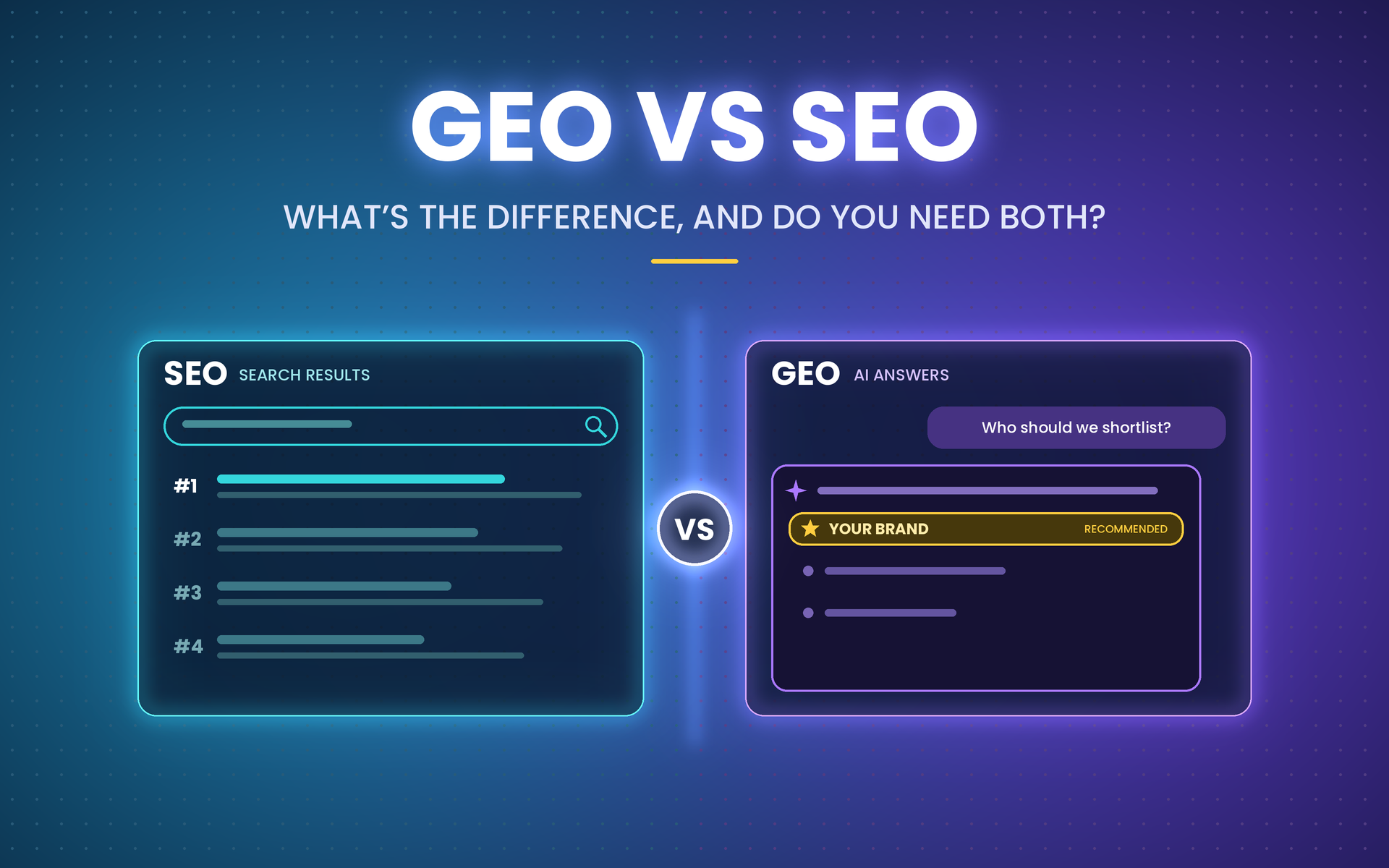
GEO (Generative Engine Optimisation) is the practice of getting your brand named, described accurately and recommended in the answers that AI assistants such as ChatGPT, Gemini, Copilot and Perplexity generate. SEO is the practice of ranking in traditional search results. In 2026, you need to understand both and approach them differently, because they work through different mechanisms and reward different things.
In brief:
• SEO ranks your pages in search results. GEO gets your brand named and recommended in AI-generated answers.
• A page can rank #1 in Google and never appear in a ChatGPT or Perplexity answer.
• A brand can be recommended by AI tools for queries where it does not rank in traditional search.
• The two reinforce each other, but neither guarantees the other.
The reason this matters: AI Overviews now appear in an estimated 43% of Google searches (TechDogs, 2026), and tools like ChatGPT, Perplexity and Copilot are an increasingly common first stop for B2B research. For example, 51% of B2B software buyers now start their research in an AI chatbot more often than in Google, and AI chatbots are the top source shaping their vendor shortlists (G2, 2026). If your brand is absent from those answers, you are missing a growing share of the decision-making process.
What is GEO (Generative Engine Optimisation)?
GEO stands for Generative Engine Optimisation. A generative engine is any AI system that writes its own answer to a query, often drawing on and citing web sources: ChatGPT, Google Gemini, Microsoft Copilot, Claude, Perplexity, and Google’s AI Overviews and AI Mode.
GEO is the discipline of influencing how those systems perceive, represent and recommend your brand when generating their answers. It is less about meta tags and more about the sum total of how your brand appears across the web: what is written about you, where you are cited, how consistently your expertise is described, and whether the signals across your digital footprint all point to the same credible, specific authority.
GEO and AEO overlap, and many practitioners use the terms interchangeably. The working distinction we use at My Bright Digital, set out in our guide to answer engine optimisation (AEO), is this: AEO is about your content being extracted and cited as the answer; GEO is about your brand being named, described accurately and recommended. Good AEO supports GEO, but a brand can have well-optimised content and still be missing when an AI assistant is asked who to hire.
GEO vs SEO: the key differences
The relationship is important: when AI tools search the web, they draw heavily on indexed pages. They can also answer from training data, and they do make mistakes: 64% of B2B buyers in G2’s survey say they encounter AI inaccuracies at least a few times a month. If the information about your brand online is thin or inconsistent, AI tools can describe you vaguely or wrongly. A strong SEO foundation of well-structured, indexed, authoritative content makes GEO significantly easier. But they are not the same activity, and success in one does not guarantee success in the other.
Why GEO matters for B2B in 2026
The shift matters most for businesses where buyers do significant research before they purchase and where being named or cited by an AI tool carries credibility.
AI tools are now a primary B2B research channel.
G2's 2026 AI Search Insight Report surveyed 1,076 B2B software decision-makers. AI chatbots were the top source shaping vendor shortlists (54%), ahead of software review sites, and 69% said an AI chatbot led them to choose a different vendor than they had planned. When a buying team asks ChatGPT 'which compliance software providers should a mid-sized fintech shortlist?', the brands that appear in the answer are the ones being evaluated. The brands that do not appear are invisible at that stage of the process, regardless of their Google ranking.
AI Overviews are reducing organic click-through rates.
Ahrefs found that when an AI Overview appears, the top-ranking page’s click-through rate is 58% lower on average. Being cited inside the Overview partially compensates: Seer Interactive found cited brands averaged 2.07% organic CTR on informational queries, against 0.94% for brands that were not cited. Ranking well no longer guarantees being cited, either. In Ahrefs’ March 2026 study of 863,000 keywords, only 38% of pages cited in AI Overviews also ranked in Google’s top 10 for that query, down from 76% in its July 2025 study, though Ahrefs notes part of that change reflects better tracking.
What drives GEO performance?
The GEO paper by Aggarwal et al. (Princeton, KDD 2024) (the study that introduced the term) found that adding statistics, quotations and cited sources raised a page's visibility in generated AI answers by up to about 40% in its tests. That is the content side, which our AEO guide covers in detail. For GEO, the bigger lever is what the rest of the web says about you.
Five factors that shape how AI tools represent your brand:
1. Cited authority: being referenced on external sites such as review platforms, industry publications, sector directories and podcasts that AI tools draw on when forming their answers.
2. Consistent entity signals: your brand description, areas of expertise, and key facts are consistent across your website, LinkedIn, Google Business Profile, press coverage, and directories. Inconsistent information makes it harder for AI tools to describe you accurately.
3. Clear category positioning: say plainly what you do, for whom and where, on your own site and in third-party profiles, so AI tools can match you to the category questions buyers ask. (For how to structure content so it gets cited, see our AEO guide.)
4. Named, credentialed authors: content attributed to a real person with verifiable expertise is a stronger trust signal than anonymous content, and builds named expertise that AI tools can associate with your brand.
5. Technical crawlability: AI crawlers including OAI-SearchBot and PerplexityBot need to be able to access your content. Since 1 July 2025, new domains added to Cloudflare block known AI crawlers by default.
Do you need SEO, GEO, or both?
The short answer is both, but the balance depends on where your buyers are in their decision-making process and what kind of queries they use.
If your buyers use Google to search for specific solutions (high-intent keyword queries), SEO remains essential. If they use ChatGPT or Perplexity to research categories, compare vendors or understand options, GEO acquires greater weight.
For most B2B companies in professional services, fintech, legal and technology, buyers use both. A procurement lead at a financial services firm might start with a ChatGPT conversation ('which compliance software providers should we shortlist?'), move to Google for specific searches ('[vendor name] reviews'), and end up on your website. Being present at each stage of that journey requires SEO and GEO working together.
How to start building GEO alongside your existing SEO
You do not need to rebuild your entire content strategy. GEO is a layer that sits on top of good SEO work. Practical starting points:
• Run a baseline: ask ChatGPT, Gemini, Copilot and Perplexity the questions your buyers ask. Note whether you are mentioned, how you are described, and which competitors and sources appear instead.
• Build entity presence: ensure your brand is consistently described across your website, LinkedIn, Google Business Profile, and any directories or review platforms relevant to your sector.
• Get cited externally: digital PR, guest contributions, client reviews on sector platforms, and consistent LinkedIn thought leadership all build the external citation footprint that AI tools rely on.
• Check technical crawlability: review your robots.txt for OAI-SearchBot and PerplexityBot, and check your Cloudflare security settings.
• Track it over time: repeat the same prompts monthly, and use Bing Webmaster Tools’ AI Performance report and Google Search Console’s Generative AI performance report (still rolling out, impressions only) to see where your pages appear.
Want to know how AI tools describe your brand?
If you would like to understand how your brand currently performs in AI-generated answers, and what the highest-impact changes would be, our team runs GEO audits as part of our SEO and AI Marketing service, or as a standalone engagement. Get in touch with us to talk about how we could help.
Sources and further reading
• Aggarwal et al. (Princeton/KDD 2024) — GEO: Generative Engine Optimization. https://arxiv.org/abs/2311.09735
• G2 — The Answer Economy: 2026 AI Search Insight Report. https://learn.g2.com/g2-2026-ai-search-insight-report
• Ahrefs, 2026 — Update: AI Overviews reduce clicks by 58%. https://ahrefs.com/blog/ai-overviews-reduce-clicks-update/
• Search Engine Journal — Ahrefs: AI Overview citations from top-ranking pages drop sharply (2026). https://www.searchenginejournal.com/google-ai-overview-citations-from-top-ranking-pages-drop-sharply/568637/
• Seer Interactive — AIO impact on Google CTR: 2026 update. https://seerinteractive.com/insights/aio-impact-on-google-ctr-2026-update
• Google Search Central — AI features and your website. https://developers.google.com/search/docs/appearance/ai-features
• Search Engine Land — Bing Webmaster Tools AI Performance report. https://searchengineland.com/bing-webmaster-tools-testing-new-ai-performance-report-468039
• Search Engine Journal — Google now reports AI search impressions in Search Console (2026). https://www.searchenginejournal.com/google-reports-ai-search-impressions-how-to-read-them/582824/
• Cloudflare default AI crawler blocking for new domains, 1 July 2025 (summary by LLMrefs). https://llmrefs.com/cloudflare-blocks-ai-crawlers
• My Bright Digital — What is AEO? The 2026 guide for B2B marketers. https://mybrightdigital.com/blog/what-is-aeo-answer-engine-optimisation-the-2026-guide-for-b2b-marketers